
Individuals affected by coronary heart disease (CHD) or a history of ischemic stroke frequently present with multiple coexisting metabolic abnormalities. This recurring clinical observation has led to the recognition that these risk factors are not isolated phenomena but are instead interconnected through shared pathophysiological mechanisms. These clustered abnormalities are collectively described as the metabolic syndrome, a multifactorial condition characterized by a constellation of metabolic disturbances that significantly increase the risk of atherosclerotic cardiovascular disease (CVD) and type 2 diabetes. Importantly, the onset and severity of these metabolic alterations are strongly influenced by aging and progressive weight gain, even within what is traditionally considered the normal range of body mass index (BMI 18.5–25 kg/m²). However, increasing evidence indicates that central adiposity, reflected by an enlarged waist circumference, is a more powerful determinant of cardiometabolic risk than total body fat, both in lean and overweight individuals.
Certain clinical conditions, including type 2 diabetes mellitus, essential hypertension, polycystic ovary syndrome (PCOS), and Cushing’s syndrome, can be viewed as extreme phenotypic manifestations of the metabolic syndrome spectrum. These disorders share overlapping metabolic dysfunctions and are all associated with a markedly elevated risk of cardiovascular complications. Their progression typically reflects a combination of genetic susceptibility, environmental exposure, and lifestyle factors, and often necessitates targeted medical intervention.
Traditional cardiovascular risk prediction models, such as the Framingham risk equations, were developed before the modern epidemic of obesity and therefore do not fully incorporate key metabolic variables such as BMI or waist circumference. As a result, they fail to capture the full impact of central obesity and insulin resistance on cardiovascular risk. In contrast, identifying individuals with metabolic syndrome approximately doubles the predictive accuracy for cardiovascular disease, while also providing a critical clinical advantage: its components are modifiable and reversible, particularly through weight reduction and lifestyle intervention.
Diagnostic Definitions and Clinical Criteria
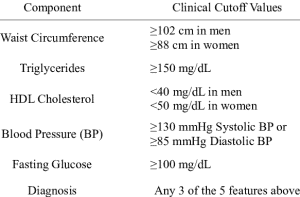
The most widely used diagnostic framework for metabolic syndrome is based on the National Cholesterol Education Program Adult Treatment Panel III (ATP III) criteria. These include threshold values for blood pressure, fasting glucose, triglycerides, HDL cholesterol, and waist circumference. Notably, these values are set below conventional treatment thresholds, but their coexistence markedly amplifies the risk of type 2 diabetes and premature cardiovascular disease. A diagnosis typically requires the presence of at least three of these metabolic abnormalities.
More recently, the International Diabetes Federation (IDF) proposed a simplified and more clinically oriented definition. This approach places central obesity—defined by a reduced waist circumference threshold as an essential prerequisite, combined with at least two additional metabolic abnormalities. The IDF criteria emphasize not only cardiovascular prevention but also early diabetes prevention, reflecting a shift toward earlier intervention strategies.
From a practical standpoint, the application of these diagnostic systems is primarily intended to guide preventive clinical management, especially focused on weight reduction and lifestyle modification. However, their requirement for fasting blood measurements limits their use in routine screening. Consequently, there is growing support for a more pragmatic approach: initiating evidence-based weight management in all individuals with increased waist circumference, regardless of other metabolic parameters.
Associated Metabolic and Hematological Abnormalities
The metabolic syndrome is frequently accompanied by additional physiological disturbances, including a pro-inflammatory state and pro-thrombotic tendencies. Elevated levels of biomarkers such as C-reactive protein (CRP), uric acid, cytokines, and plasminogen activator inhibitor-1 (PAI-1) are commonly observed. These abnormalities further contribute to endothelial dysfunction, insulin resistance, and increased cardiovascular risk.
Historically, the metabolic syndrome has been described using various terminologies, including:
- Syndrome X
- Plurimetabolic syndrome
- Reaven’s syndrome (after Gerald Reaven, who first described the clustering of metabolic abnormalities in 1988)
- Insulin resistance syndrome
However, the term “insulin resistance syndrome” is now considered incomplete, as not all components of metabolic syndrome are directly attributable to insulin resistance alone.

Etiology and Risk Determinants
The development of metabolic syndrome is strongly associated with a Westernized lifestyle, characterized by excessive caloric intake, high dietary fat consumption, and reduced physical activity. Childhood obesity is a major predictor of adult metabolic syndrome, highlighting the importance of early-life interventions. Additional contributing factors include psychosocial stress, socioeconomic deprivation, and environmental influences.
Genetic predisposition also plays a crucial role. Heritability estimates suggest that genetic factors account for approximately 30–40% of BMI variation, and up to 70% of variability in fat distribution, which is more directly linked to metabolic risk. Advances in genome-wide association studies (GWAS) have identified numerous genetic variants associated with obesity and metabolic dysfunction, including the well-known FTO gene, which influences appetite regulation and energy balance.
Although each genetic variant individually contributes only a small proportion of risk, their cumulative effect can significantly increase susceptibility to obesity and metabolic syndrome in a polygenic manner, particularly when combined with adverse environmental exposures such as poor diet, inactivity, smoking, and alcohol excess.

Pathophysiological Mechanisms
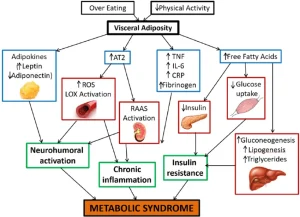
A central feature of metabolic syndrome is insulin resistance, which results in impaired glucose utilization despite elevated circulating insulin levels. This dysfunction is primarily driven by altered insulin receptor signaling and post-receptor mechanisms, often exacerbated by increased circulating free fatty acids (FFAs) originating from expanded visceral adipose tissue.
Metabolic disturbances are not uniform across tissues; insulin sensitivity varies between skeletal muscle, liver, and different adipose depots, contributing to heterogeneous clinical manifestations such as impaired glucose tolerance and type 2 diabetes.
Hypertension is also closely linked to insulin resistance, although the relationship is largely indirect. Mechanisms include sympathetic nervous system activation, renal sodium retention, and hormonal dysregulation associated with hyperinsulinemia. However, obesity remains the central driver linking these conditions.
Dyslipidemia in metabolic syndrome is characterized by elevated triglycerides, reduced HDL cholesterol, and increased small dense LDL particles, which are highly atherogenic and strongly associated with visceral fat accumulation.
Central obesity, particularly intra-abdominal (visceral) fat, plays a pivotal role in disease progression. This adipose tissue is metabolically active and functions as an endocrine organ, secreting adipokines such as leptin, adiponectin, TNF-α, and interleukins. These mediators regulate inflammation, insulin sensitivity, and vascular function. Excess secretion contributes to systemic metabolic dysfunction.
Integrative Perspective
Additional pathophysiological contributors include skeletal muscle dysfunction, sleep apnea-related hypoxia, hormonal alterations, and developmental programming during fetal life. Collectively, these mechanisms highlight the multifactorial nature of metabolic syndrome, involving complex interactions between genetics, environment, and endocrine regulation.
Chronic low-grade inflammation, reflected by elevated CRP and other inflammatory markers, further links metabolic dysfunction to cardiovascular risk. Moreover, early-life nutritional deprivation followed by excessive caloric exposure in adulthood supports the “thrifty phenotype” hypothesis, explaining increased susceptibility to metabolic disease in certain populations.
Management and Prevention Overview
The management of metabolic syndrome is primarily centered on lifestyle modification, including weight reduction, improved dietary quality, and increased physical activity. Even modest weight loss (5–10%) can significantly improve metabolic parameters. Pharmacological interventions, such as insulin sensitizers, lipid-modifying agents, and incretin-based therapies, may provide additional benefits in selected patients.
However, the most effective long-term strategy remains prevention, particularly through early identification of at-risk individuals (e.g., those with central obesity or family history) and sustained lifestyle interventions. Regular physical activity and maintenance of a healthy waist circumference are among the most powerful protective measures against the development of metabolic syndrome, type 2 diabetes, and cardiovascular disease.