

Introduction
HIV infection is a chronic viral disease caused by a retrovirus that emerged through multiple zoonotic transmission events from non-human primates to humans during the 20th century. Although these spillover events likely occurred sporadically over decades, the infection remained largely unrecognized until the early 1980s, when clusters of severe, unexplained immunodeficiency were reported in urban populations, particularly among homosexual men in the United States.
Within a short period after the identification of this new syndrome—later named Acquired Immune Deficiency Syndrome (AIDS)—scientists isolated and characterized the causative agent, Human Immunodeficiency Virus (HIV). This discovery marked the beginning of one of the most intensively studied infectious diseases in modern biomedical history.
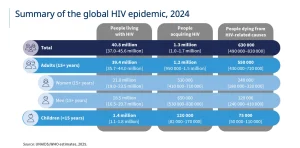
Since its emergence, HIV has infected more than 75 million people globally, with approximately 37 million individuals currently living with the virus. Despite major therapeutic advances, HIV remains one of the leading causes of infectious disease-related mortality worldwide, with the highest burden concentrated in sub-Saharan Africa. Beyond its clinical impact, HIV has profoundly affected socioeconomic development, particularly in low- and middle-income countries, as it predominantly affects adults in their most productive years, thereby reducing workforce capacity and increasing healthcare burden.
Global Epidemiology and Disease Burden
1. Worldwide distribution
HIV infection is unevenly distributed across the globe. The epidemic is generalized in many countries in sub-Saharan Africa, where prevalence rates remain the highest worldwide. In contrast, in other regions such as North America, Europe, and parts of Asia, the epidemic is more concentrated within specific high-risk populations.
2. High-risk and key populations
Certain groups, often referred to as key populations, carry a disproportionate burden of infection. These include:
- Men who have sex with men
- People who inject drugs
- Sex workers
- Transgender individuals
- Individuals in prisons and closed settings
These populations often face overlapping biological, behavioral, and structural risk factors, including stigma, discrimination, legal barriers, and reduced access to healthcare services. These barriers significantly limit access to both prevention and treatment programs, contributing to ongoing transmission.
Infants born to HIV-positive mothers also represent a high-risk group; however, this has become one of the major success stories in HIV prevention, as mother-to-child transmission can now be almost completely prevented through effective antiretroviral therapy (ART).
3. Regional variation and trends
Even within high-burden countries, prevalence varies significantly by region. For example, differences in prevalence can be observed between provinces or districts due to variations in socioeconomic conditions, healthcare access, and behavioral patterns.
Although global incidence has declined in several countries due to prevention strategies and expanded treatment coverage, new infections continue to occur at significant levels worldwide, with millions of new cases annually.
Virology and Pathogenesis
1. Viral classification
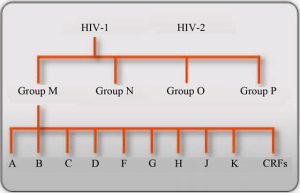
HIV exists in two main types:
- HIV-1 (most widespread and pathogenic globally)
- HIV-2 (less transmissible and primarily restricted to West Africa)
This review focuses primarily on HIV-1 due to its global dominance.
2. Cellular targets and entry mechanisms
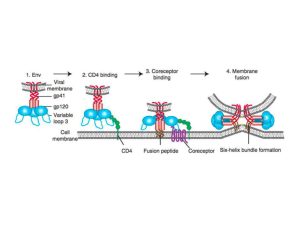
HIV primarily targets CD4+ T lymphocytes, which are essential for immune coordination. Entry into host cells requires:
- CD4 receptor binding
- Co-receptors CCR5 or CXCR4
Different viral strains may preferentially use one or both co-receptors, influencing transmission dynamics and disease progression.
3. Viral replication cycle
HIV is a retrovirus, meaning it integrates its genetic material into the host genome. Its replication cycle includes:
- Entry into host cell
- Reverse transcription of RNA into DNA
- Integration into host DNA
- Host-driven transcription and translation
- Assembly and release of new virions
This integration into host DNA is a key reason why HIV infection is currently incurable with standard therapies.
Natural History of HIV Infection
1. Acute infection phase
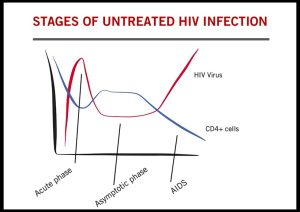
Following exposure, HIV rapidly establishes infection at mucosal surfaces and spreads to lymphoid tissues. Within days, systemic dissemination occurs, and viral RNA becomes detectable in the blood within approximately 10–14 days.
Viral replication increases exponentially and peaks around 3–4 weeks post-infection, often reaching extremely high levels. This phase is associated with high infectivity and may present with flu-like symptoms such as fever, rash, lymphadenopathy, and malaise.
2. Set point and chronic phase
Following the acute phase, the immune system partially controls viral replication, resulting in a decline in viral load to a relatively stable level known as the “viral set point.” This set point is a critical predictor of disease progression:
- High set point → faster progression to AIDS
- Low set point → slower disease progression
During this chronic phase, HIV continues to replicate at lower levels while progressively damaging the immune system.
3. Progression to AIDS
Over time, persistent viral replication leads to:
- Progressive CD4+ T cell depletion
- Chronic immune activation
- Lymphoid tissue destruction
Eventually, severe immunodeficiency develops, leading to opportunistic infections and cancers that define AIDS. Without treatment, the average progression time is approximately 8–10 years, although significant variability exists.
Viral Diversity and Evolution
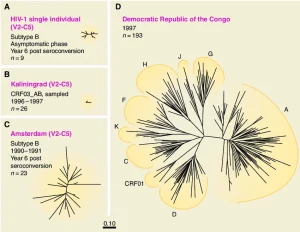
HIV exhibits extremely high genetic variability due to:
- Rapid replication
- High mutation rate
- Selective immune pressure
- Antiretroviral drug pressure
This genetic diversity allows the virus to evade immune responses and develop drug resistance. Envelope proteins, in particular, show high mutation rates and glycosylation variability, which helps shield the virus from neutralizing antibodies.
The high variability of HIV represents a major barrier to vaccine development.
Viral Reservoirs and Persistence
One of the greatest challenges in HIV eradication is the formation of latent viral reservoirs. HIV integrates into long-lived cells, particularly memory CD4+ T cells, where it remains transcriptionally silent but replication-competent.
Key features of the reservoir include:
- Early establishment (within days of infection)
- Long-term persistence (decades)
- Resistance to immune clearance
- Insensitivity to current ART
Although antiretroviral therapy blocks new infection cycles, it cannot eliminate integrated viral DNA. As a result, discontinuation of therapy leads to rapid viral rebound.
Immune Response and Immune Evasion
1. Host immune response
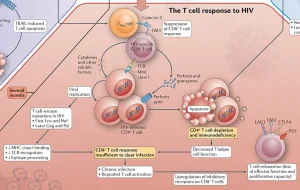
The immune system initially responds with:
- CD8+ cytotoxic T lymphocyte activation
- Antibody production
These responses reduce viral load after acute infection but fail to fully eliminate the virus.
2. Immune escape mechanisms
HIV evades immune control through multiple strategies:
- Rapid mutation of epitopes
- Glycan shielding of envelope proteins
- Downregulation of MHC class I molecules (via Nef protein)
- Inhibition of host restriction factors (APOBEC3, tetherin, SAMHD1)
These mechanisms allow HIV to persist despite strong immune pressure.
Transmission Dynamics
HIV transmission occurs through exposure to infected bodily fluids. Major routes include:
- Sexual transmission (most common globally)
- Blood exposure (e.g., injection drug use)
- Vertical transmission (mother-to-child)
Transmission risk is influenced by:
- Viral load (higher = higher risk)
- Type of exposure (anal sex carries highest sexual risk)
- Presence of co-infections
- Mucosal integrity and inflammation
Certain genetic factors, such as CCR5-Δ32 deletion, provide strong protection against infection.
Clinical Course and Disease Progression
HIV disease progression is characterized by:
- Initial acute infection with high viremia
- Partial immune control and establishment of viral set point
- Long asymptomatic chronic phase
- Gradual CD4+ T cell decline
- Development of AIDS-defining conditions
Disease progression varies widely depending on host genetics, immune response, and viral characteristics. A small subset of individuals, known as elite controllers, can naturally suppress viral replication without treatment.
Conclusion
HIV infection remains a complex, chronic infectious disease driven by continuous interaction between a highly mutable virus and a progressively weakened immune system. Despite major advances in antiretroviral therapy and prevention strategies, HIV persists globally due to its ability to establish lifelong reservoirs, evade immune responses, and exploit social and structural vulnerabilities.
However, modern biomedical interventions—including ART, pre-exposure prophylaxis, and prevention of mother-to-child transmission—have dramatically reduced mortality and new infections, demonstrating that while HIV is not yet curable, it is now a manageable and preventable chronic condition when appropriately treated.